

Freight News
US must suspend Nvidia AI chip exports to China, senators say

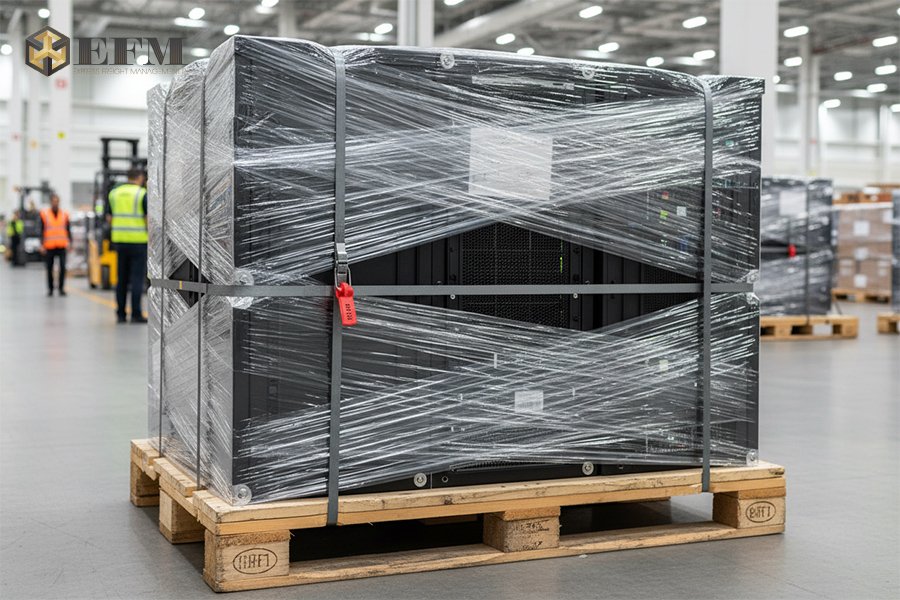
Southeast Asia serves as a critical transit hub for global technology exports. However, the United States–ASEAN trade corridor is now under pressure. Lawmakers have demanded the US commerce department suspend Nvidia’s licences to export AI chips to China and south-east Asian countries after the discovery of a large smuggling scheme. This article explains how such developments affect exporters operating between the US and ASEAN. It also outlines the steps needed to stay compliant in a stricter regulatory environment.
Further Reading: What Businesses Need to Know About Shipping to ASEAN
Background
The bipartisan request stemmed from a major Department of Justice (DOJ) indictment. Wally Liaw, co-founder of Super Micro Computer, along with two associates, were charged with conspiring to violate U.S. export laws by funneling billions of dollars worth of servers containing restricted, cutting-edge Nvidia AI chips to customers in China.
Their smuggling method relied on controlled but indirect logistics routes. Key tactics included:
- Routing shipments through Southeast Asian intermediaries before final delivery
- Falsifying shipping documents and inspection records
- Repackaging servers to remove identifying marks
Legislative Pressure

The request specifically targets shipments routed through Malaysia, Thailand, Vietnam, and Singapore. The letter also highlighted a major shift in accountability. Politicians have also criticized Nvidia’s past claims that clients “monitor themselves.” As a result, the Bureau of Industry and Security (BIS) will likely stop accepting executive assurances in lieu of hard tracking data.
Such a move shows that ASEAN is no longer treated purely as a neutral transit region. Instead, some deem it as a potential risk zone for diversion. For exporters, this means that relying on downstream partners or distributors is no longer sufficient. Responsibility is moving upstream to the original shipper.
Further Reading: Navigating Customs and Compliance Between the USA and ASEAN
Chip Security Act
Alongside enforcement actions, new legislation is being developed to close post-shipment blind spots. First introduced to address critical enforcement gaps, the proposed Chip Security Act requires strict hardware tracking. High-performance AI chips must include unalterable chip security mechanisms before leaving the country. Exporters must comply with the following mandates:
- Embed ping-based location verification software into the chip firmware before export.
- Report any deviation from the approved destination to the BIS.
NOTE: The semiconductor crackdown fits within a broader US push for supply chain security. Under the Trump administration, reliance on foreign manufacturing across the technology sector is to be heavily reduced.
Supply Chain Impact: USA-ASEAN Route

The move poses severe operational friction for standard tech shippers moving cargo to ASEAN markets. Exporters should expect increased BIS audits and heavily scrutinized end-user certificates. Even minor discrepancies can trigger shipment delays or enforcement actions. Exporters should also prep for significantly longer customs clearance times. This is especially so for major transit hubs like Singapore and Malaysia. Most importantly, chain-of-custody visibility is no longer optional. Exporters must now demonstrate full control over how goods move across each stage of the journey.
This requires:
- Secure verifiable, end-to-end tracking to prevent accidental transshipment
- Consolidate logistics networks to avoid relying on fragmented third-party brokers
Without these measures, exporters face both financial penalties and legal exposure.
Further Reading: The Importance of Accurate Documentation in Customs Clearance
Conclusion
US export controls are evolving rapidly. What was once a documentation-driven system is becoming a hardware-verified, enforcement-heavy framework.
Navigating the volatile regulations requires an experienced, unified logistics partner. Express Freight Management provides secure, one-stop B2B freight forwarding, rigorous chain-of-custody tracking, and expert customs brokerage. Consequently, high-value tech shipments between the US and ASEAN remain fully compliant with shifting trade laws under Express Freight Management’s supervision.