

Freight News
FDA Holds and Detentions Explained


Unexpected border delays disrupt supply chains when US businesses import FDA-regulated goods from ASEAN suppliers. An FDA hold stops your products from entering the US market immediately. However, it provides a brief window to prove regulatory compliance. Unresolved holds can trigger a costly Import Alert. Fortunately, most FDA holds are avoidable.
This guide outlines the timeline of an FDA import detention and options to respond before the agency issues a formal refusal.
“Detained”
An FDA detention is an administrative hold, not a criminal seizure. When the FDA detains a shipment, the goods typically remain in the importer’s physical custody or in a bonded warehouse. The government does not physically take possession of the cargo.
The legal basis for this action is Section 801(a) of the Federal Food, Drug, and Cosmetic Act. This section gives the FDA authority to refuse admission to any product that appears to violate the Act. That word “appears” carries real weight: the FDA does not need to prove a violation to detain a shipment. Reasonable grounds to suspect non-compliance are enough. The burden then shifts to the importer to demonstrate that the product meets U.S. standards.
How A Shipment Gets Flagged
Shipments trigger scrutiny for several distinct reasons.
Random exam and risk-based screening
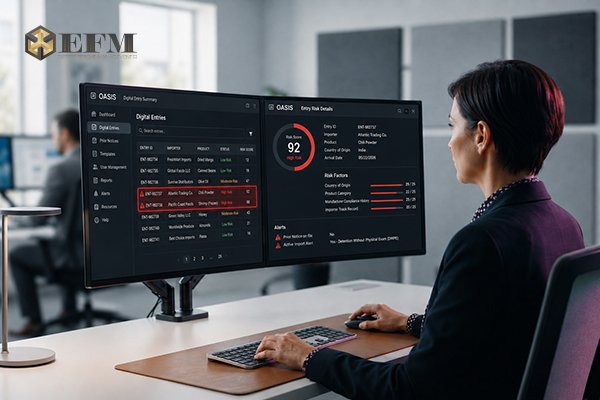
The FDA physically examines roughly 1% to 2% of all food shipments at the border. This screening process relies on the Operational and Administrative System for Import Support (OASIS). OASIS scores incoming entries against historical violation data.
The system scores shipments based on four risk criteria:
- Country of origin
- Product category
- Manufacturer compliance history
- Importer track record
A shipment that scores above the risk threshold gets pulled for physical examination. This happens even if the supplier has no prior record of violations.
Prior Notice failure or gap
Under the Food Safety Modernization Act (FSMA), importers must submit Prior Notice to the FDA before food arrives at a U.S. port. A missing, late, or materially incomplete Prior Notice is grounds for immediate detention. This rule applies regardless of whether the product itself is perfectly safe. No minimum shipment size exempts a consignment from this requirement.
Detention Without Physical Examination (DWPE)
Products associated with an active alert face immediate DWPE upon arrival. Port officials see the flag in their system and immediately pause the clearance.
Import Alerts & Red List
An Import Alert functions as a standing instruction published on the FDA website. It directs field personnel and Customs and Border Protection (CBP) to detain specific firms on arrival. Every Import Alert is published on the FDA’s website and is fully searchable. A supplier’s competitors, business partners, and potential customers can all see whether that supplier appears on one.
Firms placed on an Import Alert go straight onto the Red List. Every subsequent shipment from that firm gets flagged under DWPE automatically. This continues until the firm successfully petitions for formal removal from the registry. ASEAN manufacturers frequently appear on these lists. For example, as of writing time:
Indonesia
- Maintains 34 active alerts regarding, among others
- Seafood and Fishery Products, under Import Alert Number 16-02, 16-04, 16-105, 16-119, etc.
- Agriculture, Cocoa, and General Food, under Import Alert Number 23-14, 34-01.
- Import Alert Number 34-01 restricts cocoa beans from Brazil, Indonesia, and Malaysia due to the presence of live insects.
- Colors, Cosmetics, and Supplements, under Import Alert Number 45-02, 53-06, 53-17, 54-15.
- Drugs and Active Pharmaceutical Ingredients, under Import Alert Number 66-40, 66-41, 66-57, 66-66.
Malaysia
- Maintains 39 active alerts regarding, among others
- Seafood and Fishery Products, under Import Alert Number 16-04, 16-105, 16-119, etc.
- Agriculture, Cocoa, and Sweeteners, under Import Alert Number 34-01, 36-04.
- Colors and Cosmetics, under Import Alert Number 45-02, 53-06.
- Dietary Supplements, under Import Alert Number 54-14, 54-15, 54-16.
- Drugs and Pharmaceuticals, under Import Alert Number 66-40, 66-41, 66-57, 66-79.
The Philippines
- Maintains 40 active alerts regarding, among others
- Seafood and Fishery Products, under Import Alert Number 16-04, 16-105, 16-119, etc.
- Agriculture, Fruits, and Plant Products, under Import Alert Number 21-07, 23-12, 23-14, 31-03, etc.
- Colors, Cosmetics, and Supplements, under Import Alert Number 45-02, 53-06, 54-15.
Checking foreign manufacturers against the FDA Country-Specific Import Alert Index prior to issuing purchase orders prevents expensive port delays.
Detention Timeline
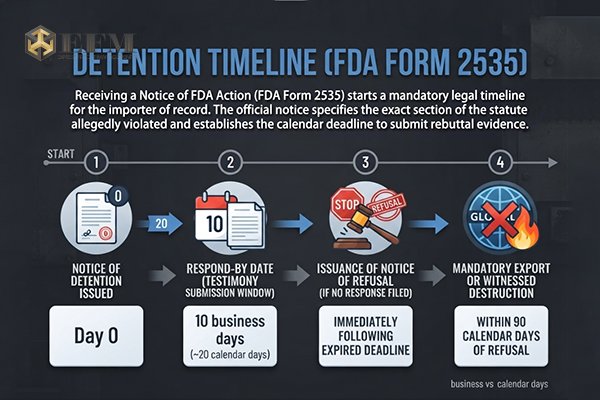
Receiving a Notice of FDA Action (FDA Form 2535) starts a mandatory legal timeline for the importer of record. The official notice specifies the exact section of the statute allegedly violated and establishes the calendar deadline to submit rebuttal evidence.
| Stage | Timeframe |
| Notice of Detention issued | Day 0 |
| Respond-by date (testimony submission window) | 10 business days (~20 calendar days) |
| Issuance of Notice of Refusal (if no response filed) | Immediately following expired deadline |
| Mandatory export or witnessed destruction | Within 90 calendar days of refusal |
The specified respond-by date does not demand final resolution of the technical issue within ten days. Importers must use this window to formally notify the compliance officer of their action plan, request an extension, or confirm that an accredited laboratory is performing analytical tests. Failing to submit an initial response within the prescribed window leads directly to entry refusal.
The importer can track detention status, upload documents, and check laboratory completion dates through the FDA’s Import Trade Auxiliary Communication System (ITACS). CBP will not release the entry until all holds recorded in ITACS are cleared.
What Happens After Refusal
Issuing a Notice of Refusal marks the formal denial of entry into domestic commerce. The importer must export the merchandise to an overseas destination or destroy the cargo under supervision within 90 days. All associated logistical expenses remain the financial responsibility of the importer.
NOTE: Customs and Border Protection monitors the destruction or re-export process.
A single refusal does not automatically place a firm on an Import Alert. Repeat violations from the same manufacturer, however, can lead there. Once a firm lands on the Red List, the consequences extend beyond one importer. Any U.S. company sourcing from that manufacturer faces automatic DWPE on every subsequent shipment, regardless of who they are.
Most Common Reasons For Detention
| Violation Type | Common Product Categories |
| Filth / Decomposition | Seafood (Indonesia, Philippines, Vietnam) |
| Veterinary drug residues (chloramphenicol, nitrofurans) | Shrimp, Farmed Fish |
| Labeling / Misbranding | Food products, Cosmetics, Dietary supplements |
| HACCP Non-compliance | All seafood |
| Unapproved Color Additives | Cosmetics, Confectionery |
| Pesticide residues above U.S. tolerance | Produce, Spices |
| FDA facility registration not on file | Drugs, Medical devices, Food facilities |
| Missing or late Prior Notice | All food shipments |
Seafood accounts for the largest single share of food refusals in the FDA import refusal database. This database tracks over 503,850 records from October 2001 through January 2026. Analysis shows that seafood consistently represents approximately 20% of all food violations across every major period analyzed.
What Importers Can Do During the Detention Window
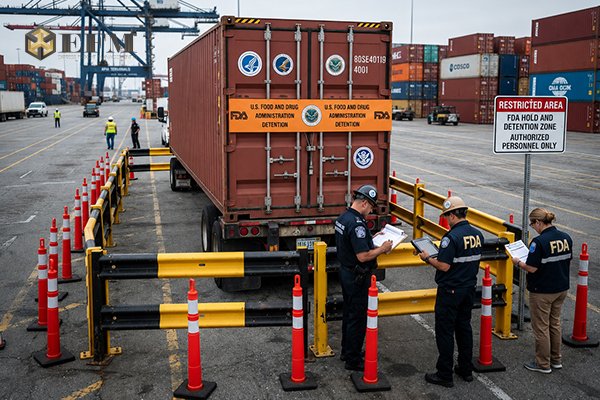
Once the Notice of FDA Action arrives, the importer has several available responses.
Submit testimony
This involves providing evidence that directly rebuts the specific charge on the Notice of Action. A labeling charge requires corrected labels and a formal reconditioning proposal. An adulteration charge requires third-party lab results from an FDA-accredited laboratory. Meanwhile, the random sample must be pulled by a recognized sampler to ensure validity.
Request a hearing
The importer has a statutory right to an oral or written hearing before the FDA district office. It is rarely the fastest path to resolution, but it is available and preserves the importer’s right to contest the detention formally.
Submit a reconditioning proposal
When physical goods violate packaging or labeling rules, the owner can file Form FDA-766 to request permission to bring the items into compliance. This work occurs within a secure, customs-bonded warehouse. Agency authorization allows workers to relabel packaging or clean specific lots under official supervision.
Check ITACS
Status updates, uploaded documents, and laboratory completion estimates all pass through ITACS. CBP will not release the shipment until every hold clears.
Getting Off the Red List
Clearing a single detained entry and being removed from DWPE are two separate processes. Unfortunately, importers sometimes conflate them.
Releasing one entry requires satisfying the FDA evidence standard for that specific shipment. The importer must rebut the stated charge with documentation that meets the division compliance office requirements. While the entry is released, the manufacturer remains on the Red List. The next shipment will be stopped again.
Removal from the Red List requires demonstrating to the FDA that the underlying conditions giving rise to the violation have been permanently corrected. In practice, this typically involves a detailed corrective action letter, supporting manufacturing records, and in most cases a series of compliant shipments verified by private laboratory analysis.
Preemptive Measures

Performing due diligence before booking cargo prevents administrative holds at American ports:
- Screen prospective manufacturers against the FDA Active Import Alert Listings before signing purchase contracts.
- Verify that the supplier maintains a valid registration using the FDA Food Facility Registration Portal.
- File electronic advance information through the FDA Prior Notice System Interface (PNSI) prior to departure.
- Review supplier labeling against FDA requirements before the shipment leaves origin. Correcting labels in a US bonded facility is far more expensive than correcting them overseas.
Maintain FSVP records for each foreign supplier as required under FSMA.
Conclusion
FDA holds follow clear patterns involving specific product categories and origin countries. The vast majority of import detentions stem from documented compliance gaps. This includes incorrect labeling, missing advance documentation, or unverified foreign production facilities. American businesses that verify supplier standing before issuing purchase orders eliminate clearance delays and protect port transit schedules.
As a freight forwarder specializing in US to ASEAN trade, Express Freight Management handles customs clearance on both ends of the corridor. We can flag known Import Alert risks for a supplier before you finalize the booking. Visit our Customs Clearance service page to learn more or contact us directly to request a free quote today!